Friday, March 26, 2021

ACCA-13: Royal Lineage (part 3)

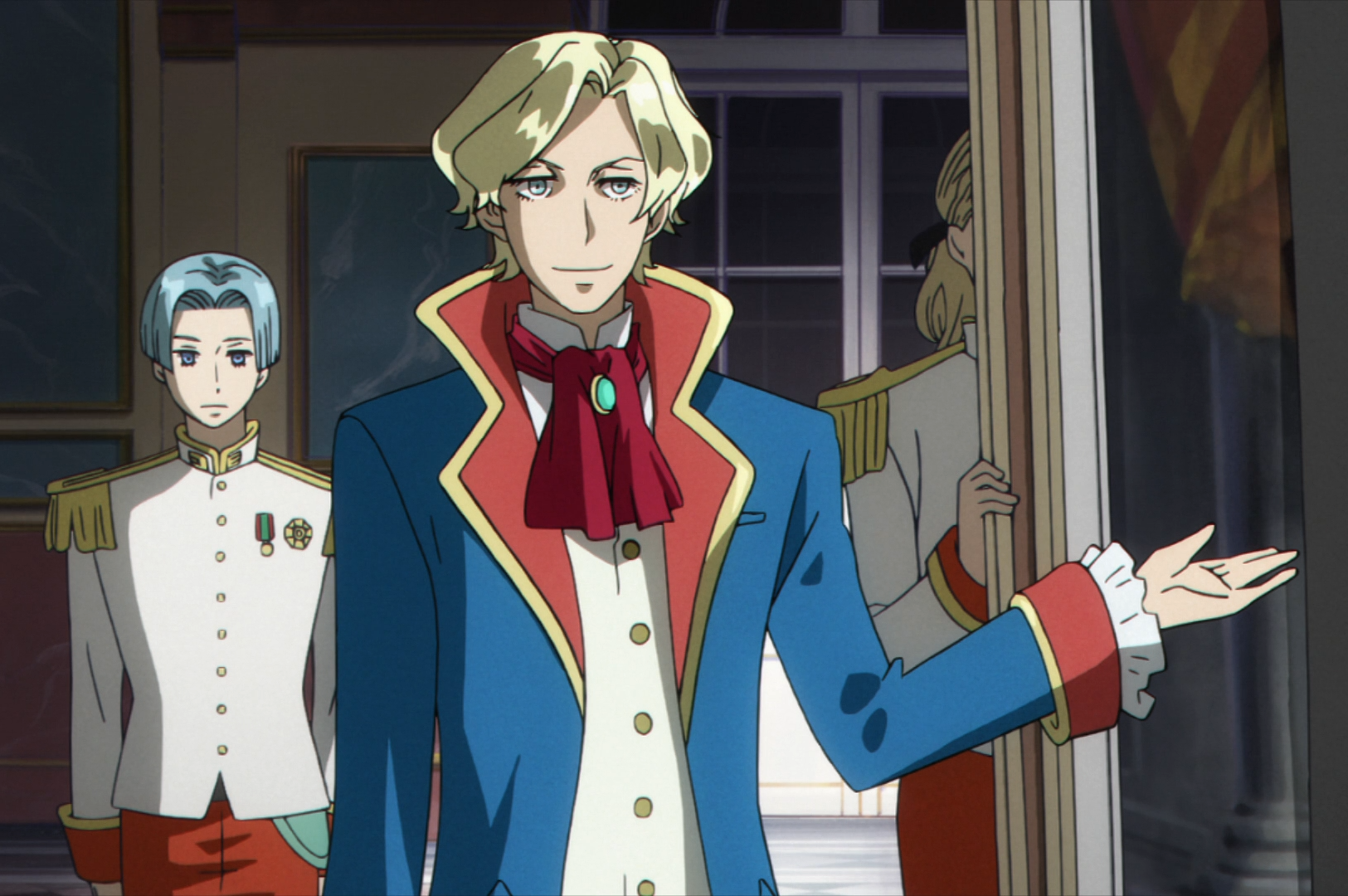
Through her separate investigation, Director-General Mauve discovers a key piece of information that sheds light on the actual mechanism behind the coup d'etat. It is revealed that Jean Otus and his sister Lotte Otus are grandchildren of the current ruling King of Dowa, and whoever started the rumor that Jean was a co-conspirator, likely seeks to replace Crown Prince Schwan with Jean. Now confident that Jean was not originally a conspirator, Mauve tells Jean of his heritage. Though initially surprised by this revelation, Jean quickly plans his next move with Mauve.

Jean learns of his royal lineage from Director-General Mauve.


With this knowledge in hand, Jean confronts Nino, his childhood friend and constant watcher, who previously alluded that his role in monitoring Jean comes not just from Chief Officer Grossular, but from someone else he cannot yet reveal. Faced with a Jean now aware of his heritage, Nino now has to contend with the implications it may have on his supposed role as co-conspirator in a coup d'etat, and decides to tell Jean of his family's history.

Nino prepares to tell Jean his family's true background.


Jean Otus' mother, Schnee Otus is the second of three sisters and daughter of the current ruling King Falke. During her youth, Princess Schnee frequently traveled to the Kingdom's districts to study and became enamored with life outside of the palace. Unfortunately, her fascination with the outside world also included her passion for politics, raising concerns that she may become a political liability on the royal family. However, filled with love for her curious and worldly daughter, King Falke did not wish to prevent Princess Schnee from pursuing her passion and explore the outside world.

To allow the Princess to experience the world as well as to prevent the family's reputation from becoming besmirched, King Falke arranges to have her removed from the Dowa family registry and to send her out to Badon to live as a commoner. To ensure her well-being and to report on her life to the King, Abend of the Guard Corps who serves as Princess Schnee's aide is also sent along with her, but is made to give up his family and position to keep the Princesses existence a secret. To aid in his duties in monitoring the Princess in her new life, Abend also takes his personal aide and his son, Nino. With the plan set, Princess Schnee and Abend's disappearance is explained away by a tour boat that sinks mid voyage to the Peshi district.

A solemn King Falke bids farewell to Princess Schnee.


Thursday, March 25, 2021

ACCA-13: Rumors of a Coup D'etat (part 2)

At a meeting between the Five Chief Officers, Chief Officer Grossular notifies the group of a rumor that could endanger the peace and stability of the kingdom. According to this rumor, conspirators are plotting to overthrow the monarchy, and Jean Otus of the Inspection Department is their messenger, using his natural position as an Inspection officer to travel to each of the district to coordinate the plot.

Chief Officer Grossular of the Five Chief Officers.


Concerned that the very department responsible for overseeing ACCA-13 may now bring it ruin, Grossular decides to employ "Crow" of the Internal Affairs to surveil Jean Otus as he travels to each district to conduct his audits. Crow's true identity is Nino, a close childhood friend of Jean Otus. Of particular note, during his meeting with Grossular, Nino tells his superior that the other Chief Officers will soon realize that the rumors of Jean's involvement in the conspiracy to overthrow the monarchy is in fact true, suggesting that Grossular's source of information of the rumors of the coup d'etat and Jean's purported involvement is none other than Nino.

Nino meeting with Chief Officer Grossular


With Grossular's announcement of a potential coup d'etat plot and his intent to investigate the matter, the stage is now set. Each with their own agendas, senior officers of ACCA-13 begin to move in secrecy, and in caught in the middle of their political machinations is Jean Otus. Named as a possible co-conspirator, Jean suddenly finds himself at the center of attention of the most powerful individuals of ACCA-13.

While rumors of a coup d'etat have always nagged the Kingdom since the failed attempt 150 years ago, several key political events loom on the horizon which give greater credence to its legitimacy. First, the current ruling King Falke has just celebrated his 99th birthday, and while his health is not an immediate concern, the Crown Prince Schwan is also expecting to celebrate his coming of age, which makes him eligible to take the throne. There is an expectation that the King will soon abdicate to allow the Crown Prince to be coronated as the new ruler. It is also no secret among the political elites that the Crown Prince harbors ambitions to strengthen the Dowa family's control over the Kingdom by dissolving ACCA-13 and the legislative. With the fate of the Kingdom's future at hand, what would have been dismissed as mere rumor now warrants greater scrutiny.

Crown Prince Schwan maneuvers to ensure his ascendance.


After learning about the rumors of a coup d'etat from Grossular, Chief Officer Lilium seeks out Jean Otus. In a discreet meeting in a car, Lilium reveals to Jean what Grossular had told him, of the rumors of a coup d'etat, and that he has been identified as a co-conspirator and messenger. Furthermore, he also reveals that a member of the Internal Affairs is surveilling him, and that Jean may already know this man intimately. Finally, Lilium assures Jean that he does not believe that Jean is involved in the conspiracy and that instead, he believes that Grossular is the true conspirator who is spreading the rumors of a coup d'etat.

Chief Officer Lilium secretly meets with Jean Otus.


Having learned of the the rumors of a coup d'etat from her own sources, Director-General Mauve initiates an investigation but is shortly ordered to cease by Grossular. Undeterred, Mauve seeks out Jean Otus to recruit his help, though fully aware of the possibility that he may be a co-conspirator. In a clandestine dinner meeting, Mauve asks Jean to report back to her after his audits to each of the districts on any information regarding the coup d'etat. She also confides in Jean that while she believes the Crown Prince is a fool who will bring ruin to the Kingdom, a coup d'etat may lead to serious harm to the people if it were to escalate into civil war, which goes against ACCA-13's mission in preserving order and protecting the people. While employing Jean Otus as her agent, Mauve is still unsure of Jean's true allegiances and initiates a separate investigation on Jean and the coup d'etat.

Director-General Mauve recruits Jean Otus as her agent.


Rumors of Jean's supposed role as co-conspirator and messenger for the coup d'etat spreads throughout the Kingdom, and Jean finds himself in an awkward position as he travels to the districts for his audits. As Jean meets with the branch chiefs during his travels, they attempt to delicately probe Jean's position to ascertain whether he truly is a co-conspirator. Using this opportunity, Jean decides to play into the role as co-conspirator and messenger to learn more about the plot, and to his surprise, he discovers that while there seems to be no concrete plans of a coup d'etat, there is a definite underlying appetite for it among the senior ACCA-13 branch officers. However, what Jean still cannot understand is why a relatively unimportant individual like himself has been named a conspirator in a plot he is not involved in.

Jean with Hare district's branch officers.


Wednesday, March 24, 2021

ACCA-13: A Tale of Conspiracies (part 1)

For a century, the Kingdom of Dowa and its federation of 13 distinct and diverse nations (now known as districts) united under a single monarchy has continued its existence in peace and stability without much fanfare. This fortune has been credited to the work of the bureaucratic agency known as ACCA-13 that manages the Kingdom and provides government services. However, under this guise of multicultural solidarity and coexistence brews a conspiracy to overthrow the monarchy, threatening to end the 100 years of peace and stability that the Kingdom has enjoyed. With the fate of the Kingdom at play, senior officers of ACCA-13 and members of the Dowa family move to use the situation to their own ends, and at the center of this tale of conspiracies and political intrigue sits Jean Otus of ACCA-13's Inspection Department.

Deputy Chief Jean Otus with his iconic tobacco and lighter.


The Dowa Kingdom and the Federation of 13 Districts

In episode 2, we learn a little about the history of the Kingdom of Dowa, namely its violent past and the origins behind the creation of ACCA-13. Roughly 200 years ago, the Kingdom of Dowa united the 12 other nations under its banner leading to the creation of the federation. However, this was short lived as just after 50 years, the 12 nations attempted to secede, leading to a violent struggle for independence.

The 13 districts that make up the Dowa Kingdom


The coup d'etat attempt by the 12 nations ultimately failed and the Dowa Kingdom was able to reassert its supremacy, and in order to prevent a future civil war, the Dowa Kingdom negotiated and granted semi-autonomy to the 12 nations and established ACCA-13, a civilian agency that was independent from the Dowa monarchy to manage the Kingdom and to provide government services. The non-militarized nature of ACCA-13, along with its independence from the Dowa family was specifically arranged to emphasize and guarantee autonomy of the districts and to ensure equitable distribution of power in the administration of the Kingdom. Interestingly, the name behind ACCA-31 comes from a since extinct bird called Acca, which symbolizes peace.

The extinct bird of peace, Acca.


ACCA-13

Established after thwarting the coup d'etat attempt by the 12 districts, ACCA-13 is a bureaucratic agency responsible for maintaining peace and stability of the Kingdom by providing government services. Additionally, while not explicitly stated as its mission, the Dowa family likely sought to use ACCA-13 as an oversight mechanism to monitor and deal with dissenting elements to prevent another coup d'etat attempt.

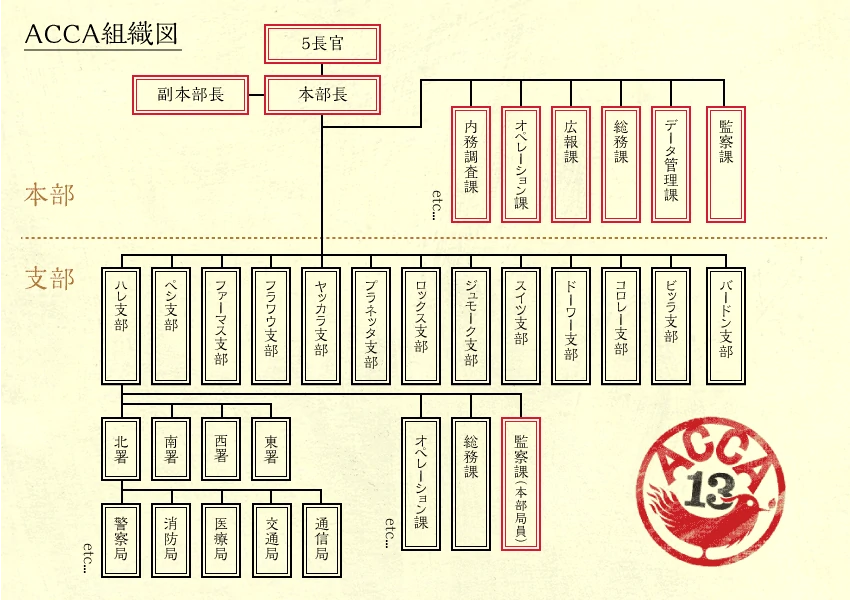
Structurally, ACCA-13 is a sprawling leviathan that has numerous departments such as the Police Department, Internal Affairs, and the Inspection Department. With its Headquarters situated at the affluent metropolis that is the Badon district, ACCA-13 is able to exert near complete control and oversight over the 13 districts through its branch offices at each of the districts. And to ensure proper administration of each district, officers of the Inspection Department travel to the branch offices to conduct audits on its own members. At the top of ACCA-13 sits the Five Chief Officers who serve as the highest deliberating body within the agency who then delegates execution of their decision to the Director-General.

The organizational structure of ACCA-13.


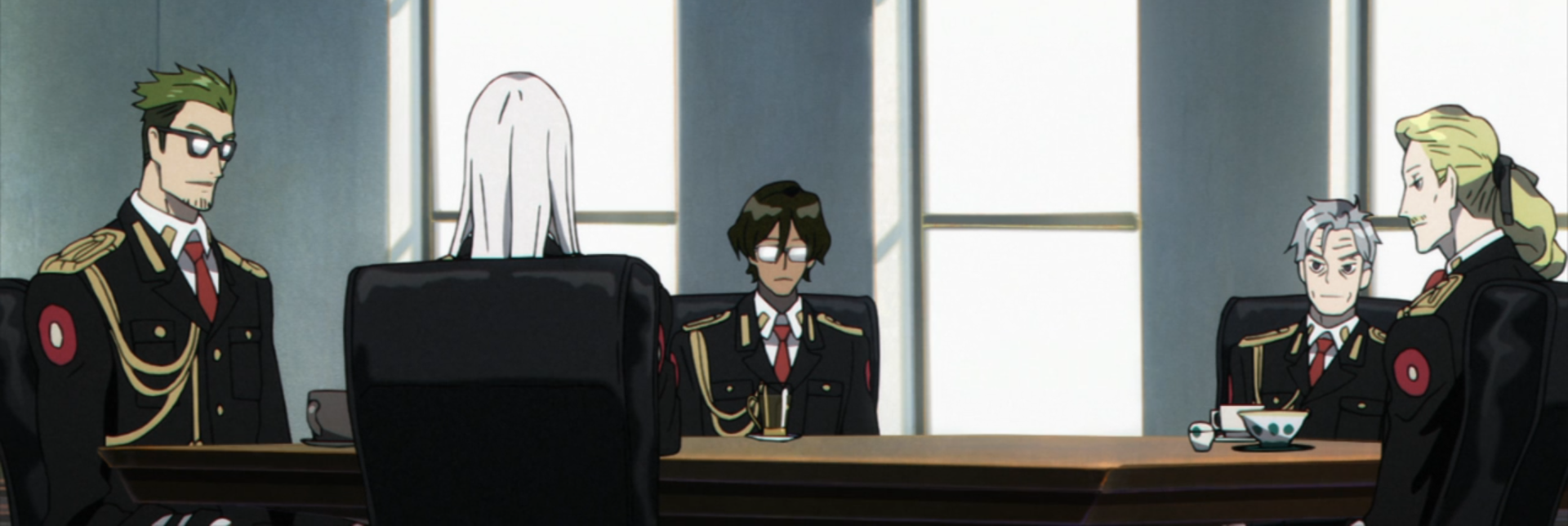
The Five Chief Officers, from left to right:
Pine, Grossular, Lilium, Spade, Pastis


Director-General Mauve.


Jean Otus

Born and raised in the Badon district, Jean Otus is the oldest child of Schnee and Karl Otus, who passed away from a train accident. Having inherited his parents' role as manager of a high-rise apartment complex, Jean lives a mundane but enjoyable life with his sister Lotta Otus, who both share a love for sandwich breads and dining out with their childhood friend Nino.

Jean, Lotto, and Nino enjoy an outing.


During the day, Jean Otus works as the Deputy Chief of ACCA-13's Inspection Department, alongside Chief Owl and his several lively colleagues who always find time to snack on sweets during work hours. Per his duties as Inspection officer, Jean frequently travels to the 13 districts to conduct audits on the work of ACCA-13 officers, but is more often than preoccupied with his sister Lotte's demands for souvenirs. While he normally visits each district once every two years, he is given sudden instructions to audit all 13 districts in just 6 months per instructions from the Five Chief Officers.

Jean brings souvenirs from his audits for his colleagues.
Chief Owl pictured in fore.


While Jean is often overlooked for his nonchalant demeanor and his disarmingly droopy eyes, behind this unremarkable facade hides a complex character filled with duality. Born of average parents, Jean professes that he has no money nor connections, but is the manager of a fancy apartment building home to elites and senior government officials. And although he laments that his salary as a Headquarters officer is lower than that of Badon's branch officers despite being in the same district, he is never seen without a cigarette, which are so expensive and heavily taxed that they are called "hobby of rich folk". Furthermore, despite his responsibility as an Inspection officer to oversee and prevent corruption and fraud within ACCA-13, he is quick to overlook such instances, brushing them off as being "out of his jurisdiction", hinting at his inclination to play by his own morals over rigid rules. And finally, despite having no grand aspirations or strong feelings about the current political system, Jean finds himself swept up in a plot to overthrow the Dowa monarchy.

Tuesday, March 9, 2021

Indomitable China

In the last several decades, China has grown to be a world superpower in every sense of the word, from being the industrial workhorse of the world, wielding immense political power to sway international events, to developing an increasingly sophisticated and advanced military force comparable to that of the most powerful nations in the world. However, in the backdrop of such a meteoric rise in such a short span following the dominance of the Chinese Communist Party (CCP) after the centuries of humiliation and subjugation under foreign powers, China has been a common target of international criticism for a variety of "bad behaviors". One prominent point that the public and press often cite is the Chinese human rights violation, to include most recently, its treatment of a minority ethnic and religious group Uyghurs. However, ever since its inception, China has maintained a ideological zealotry to sovereignty that seemingly renders them immune to international pressure, and certainly their rise in prominence in the international stage has only further cemented their behaviors.

An oft asked question is, why does the international community let China continue its oppression of ethnic minorities like the Uyghurs? More specifically, I read a social media post recently that prompted this piece, which asserted that the whole world should join arms in applying overwhelming and whatever pressure possible to force Chinese submission. While my immediate and visceral reaction was to brush it off as exceedingly naive and uninformed on international affairs, I figured that it was a good opportunity to explore the various tools in the diplomatic kit that the U.S. and other countries have and how effective they have been in achieving their goals. To that end, I will explore what sort of challenges exist in pressuring China, and what the U.S. and the international community have already tried against China in recent years and what their outcomes were.

Tools of the Trade

First, I want to explore the very notion of effecting change in another country. Generally, countries will attempt to influence each other using economics, diplomacy, and/or military with either positive or negative incentives. To give a concrete example, let us explore the following scenario. The U.S. in coalition with international partners imposes broad economic sanctions on China in order to change their behavior in regards to their poor treatment of ethnic and religious minorities in China. To simplify this scenario, the U.S. would be engaging in diplomacy with partners to create a sanctions regime that imposes a negative economic incentive on China. That is to say, if China does not change their behavior, they will suffer economically. However, whether China decides to submit to international pressure or not will depend on several different factors and ultimately, China has to come to the conclusion that continuing their behavior is not worth the negative economic impact from the sanctions.

  • Barriers to Success

The concept behind the above example is relatively simple, but effective implementation of such measures is far more difficult, and doubly so in actually achieving your intended outcome. Let us go through the hypothetical scenario step by step and see where we encounter challenges that makes this not such a simple endeavor.

While the U.S. can impose unilateral sanctions against China, this is unlikely to be sufficiently painful enough for China to induce any change. While the U.S. and China are admittedly large trading partners, the relationship is such that the U.S. is proportionately a net exporter of Chinese goods. If the trade between the two countries were to come at a screeching halt, while it is plausible that given sufficient time, other countries could replace China, it would take a gargantuan undertaking of building industrial capacity on a level that no other country is currently capable of for such a wide variety of goods. However, China has the convenience of simply shifting its export of goods to any other trade partner in the world. While China would also suffer from logistical challenges as it establishes new destinations for its goods, comparatively speaking, it would be less costly for China.

Therefore, in order to have maximum impact, the U.S. would need the cooperation of international partners to impose economic sanctions on China. However, the typical mechanism for international sanctions through the UN would not be available given that China is a permanent member of the UN Security Council, giving it absolute veto powers. The U.S. then would have to engage in a complicated dance of diplomacy through multiple countries to get their cooperation in sanctioning China. And many of these countries like the U.S. are heavily dependent on China for trade, making any sanctions costly for them and likely politically inconvenient for them domestically.

Let us suppose that such a coalition of international partners were amassed to impose significant economic sanctions against China. While it is difficult to speculate in such a hypothetical scenario, we must consider that ideologically, China has maintained strict adherence to preserving its sovereignty and not bending to foreign intervention. As was the case during the Cold War when western powers sought to prevent the spread of communism, even during the heights of mass famine of "The Great Leap", China sought it in its best interest to actively fight against western economic and military pressure, to the point of engaging in direct combat with UN forces in the Korean War, and indirectly confronting U.S. forces in Vietnam. Considering that the poor treatment of Uyghurs are part of China's greater cultural project of homogenization to solidify the CCP's control over the country against dissidents or factional elements, it would take a great amount of pain for China to reverse course. For China, absolute control over the populace is a matter of survival of the ruling regime, and not simply a sadistic fancy of some spoiled princeling.

Past Efforts

History has much to tell us on U.S. efforts in trying to change China's behavior on the international stage. In short order, I will explore three separate examples, each covering economy, diplomacy, and military.

  • Trade War

Fortunately, we have a convenient example of the recent Trump administration's "trade war" against China, which is ironically a unilateral juxtaposition of the multilateral effort of the Trans-Pacific Partnership trade agreement from the Obama administration. Without going into the convoluted details of the justification behind the "trade war", we will simply explore its mechanics and whether a positive outcome was gained. The ultimate goal of the U.S. was to change China's behavior in what was considered unfair trade practices. The leverage that the administration chose to effect a change was unilateral trade tariffs against Chinese goods entering the U.S. with the first measures taking effect in 2018 and additional measures being added until the Biden administration took power in early 2021. Ultimately, while there were several working level negotiations that occurred between the U.S. and China, 2 years of intensely escalating tariffs did not yield in any long term behavioral change in China's trade policy. Instead, many economists estimate that the cost of the tariffs negatively impacted global growth by several percentage points and only served to sour U.S. relations with other countries with whom it tried to compel cooperation.

  • Sanctions Enforcement

Since their first nuclear testings in the early 90s, the U.S. along with the international community has enforced strict sanctions regimes against North Korea. However, its two neighbors China and Russia has always proved to be a challenge in pressuring the North Koreans as they continue to trade and allow workers in flagrant violation of UN sanctions. While the U.S. has continuously sought to liaise cooperation from the Chinese through diplomatic channels and through threats of secondary sanctions enforcement, it has had little effect in changing China's willingness to supply North Korea with the precious foreign currency it needs to continue to survive under the sanctions and to continue developing its nuclear capabilities. For China, their decision to circumvent the UN sanctions which they agreed upon as a permanent member on the UN security council has faced diplomatic consequences in the form of deteriorated relations with the U.S. and other likeminded partners, and economic consequences in the form of secondary economic sanctions from the U.S. designating Chinese entities and preventing their use of U.S.-based financial services and institutions. It seems likely to conclude that to the Chinese, these costs are insufficient to the value that North Korea has as a strategic buffer zone to U.S. military forces on South Korea and Japan, making such consequences trivial to what they would lose in return if they were to submit to U.S. demands.

  • Vietnam War

During the height of the Cold War in the 60s, the U.S. was attempting to thwart further spread of communism to the greater Asia region to include Vietnam. In part to dissuade Chinese involvement in Vietnam, the U.S. decided to deploy thousands of military throughout the early 60s, which was increasingly met by Chinese military assistance to North Vietnam. From memoirs of Secretary of Defense Robert McNamara, we get a glimpse of the Kennedy administration's calculus in increasing pressure in Asia in the hopes that, a weakened China suffering from mass starvation from the Great Leap Forward, would feel under prepared to exert its power abroad. Consequently, what was intended to be an incremental buildup of U.S. military involvement in Vietnam to dissuade and counter Chinese forces, it inversely only served to ratchet up the affair on both ends. In simple terms, the U.S. sought to effect change in China's behavior in spreading communist ideology to the region through military pressure, which culminated in a indirect confrontation between the two which the U.S. eventually withdrew from.

Conclusion 

China is a very resilient country. It has weathered the fall of the communist bloc, periods of terrible mismanagement which costed millions of lives, and more recently, it has weathered numerous worldwide financial crises, and even a global pandemic. Yet despite such all that, China seems to be stronger than ever before, and emboldened to project its economic, political, and military might abroad. The threat to its immediate neighbors are a given, but we see China expand its influence to the rest of the world, including entangling Africa under considerable amount of debt, and embedding students, scholars, and skilled workers into the western world. Is it an inevitable conclusion that China overtakes the U.S. as the dominant power in all realms of the international space? Certainly, the traditional methods by which the U.S. has been able to exert its influence to effect desirable outcomes in foreign countries seem wholly ineffective on China, and they appear more than willing to turn the same tools back around against U.S. interests with great success. For years, people have debated on a strategic and graceful U.S. "abdication" of world hegemony to a "burden sharing" policy with China as a means of incorporating China into the international systems that were previously led by the U.S. in the hopes that they become a "responsible" superpower. But there is always the fear that an authoritarian system like China is susceptible to abusing their powers to the detriment of the world. As for me, I don't quite know what the right answer is, but it does appear to me that the methods that the U.S. has employed in the past century simply do not work when it comes to China and there needs to be a paradigm shift in how we approach this problem. And that does not include "simply" sanctioning China until they submit as some people might say.

Sunday, February 11, 2018

Cannibalism: The Human Animal

In modernity, the act of cannibalism is a social taboo of the highest order; an act considered so vile that it commonly captures our imagination in the horrors of fiction in the form of human devouring monsters. But what about cannibalism terrifies us so, to the point where the act is reviled by society and subject to harsh punishment of law? In the US, while there are no laws that forbid cannibalism per se, there are state laws regarding the desecration of the body that would prohibit a person from engaging in cannibalism. And throughout the rest of the world, cannibalism is universally condemned as a violation of social norms and a thing of illegality. In contrast, within the animal (and insect) kingdom, occurrences of cannibalism is a fact of life, where the want for survival trumps all, and our humanly disposition against cannibalism is an oddity rather than a norm of living organisms.

The Case of a Stranded Boat
Historically, there have been famous cases where the social norms and laws against cannibalism were tested, and perhaps one of the most well known is the case of Her Majesty the Queen v. Tom Dudley and Edwin Stephens. In short, a crew of four were sailing a yacht when they encountered unfavorable weather which rendered their boat inoperable, and the Captain ordered the lifeboat be lowered and the crew abandoned ship. The crew then had to survive on the lifeboat in dangerous conditions with very limited supplies until they were rescued after 24 days. During this time, one of the member fell seriously ill and was comatose (presumed to be fated to death soon thereafter by the remaining crew), and with their rations depleted, Dudley and Stephens decided to kill the man and consume him. The remaining member of the crew, Edmund Brooks, abstained in the killing and eating. After their rescue, the two men who engaged in cannibalism were put on trial, though their sentences were reduced from the death penalty to 60 days in prison.

The case against the men were that they had committed homicide, and the defense being that the men had acted in their own defense of their live, which incidentally was through murder. And so, this became a classic case of taking another's life for the preservation of self, putting into question just how far the concept of "self-defense" extended in a legal sense. Beyond the legality of it however, there is also the ethical question behind the act of desperate cannibalism. In retrospect, we know that the men may have survived even if they did not engage in cannibalism, given that 4~5 days after killing and eating their former member, the remaining crew were rescued. What is important though is the motives behind the act, and in this case, Dudley and Stephens acted with the belief that if they did not kill and eat Parker, they themselves would eventually meet the same fate.

If we were to suppose that without killing Parker, the rest of the crew would have eventually succumbed to starvation and death, and by killing Parker, they were able to live sufficiently long enough for rescue to arrive, does this change the answer to the morality behind taking another's life for one's own?

The Cannibal
In the case above, there was a irreconcilable difference between what is dictated as just deserts by law, and what was believed to be justice accordance to social principles (the reality of the ruling is more nuanced than that, I admit, but for simplicity of the argument, I will focus on the nature of law and justice and its relation to social norms). That is to say, while murder is a social taboo, the peculiar circumstances in which, the murder of Parker was believed to be necessary to the crew's survival, made the issue far more complicated. And furthermore, the contention did not end at the murder, but also in the act of cannibalism, which has a quality to it unlike others to trigger such a revulsion, violating the very sense of what defines us as humans.

What is it about cannibalism rouses such a response? From an objective point of view, the consumption of meat is a necessity to one's survival, and we as humans partake in the consumption of meat of other dead beings without raising an eye brow (with the exception of vegans, and particular religious prohibition of certain kind of meats, which is a interesting point to consider as well). If we are capable of consuming the meat of cows and chickens, how is this materially different from that of consuming humans? And even before that, why are certain acts considered "desecration" of the dead? Are they not already far removed from the world of the living, no longer drawing breath to know or care what we do with their corpse?

One explanation behind this human "peculiarity" may lie with our higher cognitive capabilities that allow us to experience a range of emotions, from empathy to various levels of kinship (ranging from the smallest unit of the familial all the way to a sense of single unity as humans). And with our higher cognitive capabilities, we have imbued the dead with the characteristics of the living, elevating a heap of corpse to that of what we call to be "human". In India, we see this mechanism employed to elevate the status of cows to that of a respected being, and therefore, making it a being not appropriate for consumption. And of course, there is religion to consider, among innumerable others, which I will not explore for the sake of brevity; the important point is that cannibalism does not seem to be an adverse behavior as far as reproduction is considered. If the revulsion of cannibalism is an element of social norms without a biological component, is the transgression of these norms worthy of punishment even in circumstances of life and death?

Apart from basic biological necessities (food, water and shelter), human society is tightly bound by rules and norms to uphold the principles that make up our "humanity", away from the animalistic behavior based on primal instinct. In that sense, our proclivity to safeguard these principles is a defense of what defines us as humans, lest we become slave to the "rules of nature" where survival and procreation dictate all. And to those who violate these norms, society is eager to shun, as if to protect and preserve their notion of superiority as "humans" beyond simple biological machines that act in accordance to their natural making.

Conclusion
In the case of the lifeboat, the argument of the murder as a necessary defense of one's own life is a very contentious matter. It is true that in our society, certain acts of violence are permissible (at least legally speaking) if the perpetrator was acting in credible defense of their own life. And yet, the act of cannibalism, or in this case, a murder for the purpose of cannibalism seems to evoke a revulsion as if the act is a kind of attack on our identity as humans. Post-apocalypse fiction is a genre that often tackles this very question of what it means to be human, and when thrust upon the most trying conditions, when we forgo the conventions of our societal norms for the sake of survival become a thing that is less than human?

Saturday, February 3, 2018

Bloody Nose for a Cracked Fist

With the lack of progress in achieving a non-military solution to the DPRK's continued belligerence in regards to nuclear development, the possibility of a limited attack (bloody nose) looms menacingly above our heads. In its essence, the use of violence is the physical manifestation of political discourse. That is to say, violence is never a means and an end to itself, but rather, a continuation, and most often, the apex of a conversation between two states. As such, the pursuit of military action must not be an invocation of emotional response, and instead, must be part of a considered and deliberate stratagem to elicit specific reactions.

The Feasibility of Limited Attack
The doctrine of Mutually Assured Destruction (M.A.D.) tells us that the possession of weapons of mass destruction between opposing parties will lead to a scenario in which use of the weapons will result in a full-scale exchange, ensuring the total annihilation of all parties involved. And interestingly, the scale of the destructive power of nuclear weapons allows for a equilibrium between parties of asymmetric nuclear capability. This is in part due to the relative "risk" that is involved in a nuclear exchange, and the asymmetry of "pain tolerance" between states of very disproportionate economic power. To use a silly analogy, a nuclear fight is like that of two people in a pit of oil, one with a single match, and the other, with a whole box of matches.

However, the existence of nuclear weapons is not an end to traditional forms of conflict, and certainly not an end to limited military actions or exchanges between nations. As history has shown us, the military rivalry between the US and Soviet Union did not spell an end to the conflict, and while it did have the effect of preventing a full-out war between the two nations, conflict via proxies took the stage as the language of violence during the Cold War. And similarly, the history between the US (and by association, the ROK) and the DPRK is riddled with small exchanges, and although the DPRK lacked the means of a nuclear strike against either US or ROK in the past, they were not foreign to showing their willingness to use military action.

If the US were to hold itself to its words, the possibility of a limited attack seems very real. With the US unwilling to yield in its demand for de-nuclearization, the continued development of both delivery methods and stockpile may force a response. Alternatively, there is also the possibility that the ordeal with the DPRK will end similarly to Obama's administration's demand for Assad to step down. This demand was not reasonable given the scale of commitment of the US (which severely hampered our ability to leverage our wants in the situation), and despite that, the US maintained this position until the problem became obsolete with the change of the Presidency (though the new incumbent may feel less regard for upholding the threats and promises of the previous administration, the inability to enforce the "red line" serves to undermine US leadership and credibility). Like Syria, the current administration may elect for the same "solution", opting for no real actions while the DPRK continues to defy the US.

The Carrot and Stick
The Trump administration's policy towards the DPRK is as follows: There is no acceptable alternative for the US but for complete de-nuclearization of the DPRK. And unfortunately, there has been no clear details as to what form of de-nuclearization would be acceptable to the US, making it not only a categorical antithesis to the nuclear policy of the DPRK, but also a non-negotiable starting point.

In the use of a limited attack, the US would have to communicate clear terms under which the US will exercise the use of further violence if demands are not met. These terms however, cannot be total de-nuclearization of the country, and must allow for a condition that can reasonably be fulfilled by the opposing party (or at least a demand that can be entertained and perhaps negotiated upon). However, diplomacy has a pre-requisition of mutual trust, and with the hostility and clear lack of trust shown between the two countries, the likelihood of success seem dim (from the perspective of the DPRK, it would be prudent to wait for a new administration that more closely embodies the traditional inclinations of the US, which would make far stabler grounds for negotiations).

Furthermore, the recent successes of talks between the DPRK and ROK will be a challenging roadblock for the US in terms of negotiating with the DPRK. ROK's breakaway from the bloc of US led sanctions against DPRK weakens US bargaining position, especially given the fact that any limited attack against DPRK would require close cooperation and buy-in to the plan by the ROK. And having finally managed to find some common ground and deescalation to the situation, a move to introduce military action into the situation would likely garner harsh repudiation by the international community, isolating the US in its negotiation efforts and possibly endangering the sanctions regime (which is already faltering for innumerable reasons).

Conclusion
In the present scenario, it is difficult to imagine a positive outcome to a limited attack, which would only serve to validate DPRK's efforts for self defense, isolate the US from its allies in negotiations, and escalate tensions when it was just on its way down. As discussed in previous works, the DPRK is not in a position to be negotiated to total nuclear disarmament and a limited attack with such preconditions would necessitate a hard reaction from the DPRK. And with the talks with DPRK and ROK progressing, a limited attack would serve to derail those talks, sour our relation with the ROK, and would ultimately do disservice to the effort of pacifying the peninsula.

While the likelihood of a positive outcome from a limited attack is very slim, the US has maneuvered itself into a terrible position, where we must choose from bad and worse options. And with the credibility of the US at risk, and with the long term dangers of "kicking the can" down the road yet again, military action is still a very real possibility. There is also the added domestic political situation to consider, where the need for domestic approval for midterm elections and a second term Presidency may trump (no pun intended) the negative consequences of such actions.

Saturday, January 27, 2018

North Korea: Nuclear Diplomacy

"Let us sit about, and speak feverishly. Chatting into the wee hours of..."
- Micolash

As a North Korea watcher, the recent fervor of activity, discourse, and interest in the ongoing dilemma of the divided Koreas has been exhilarating and seeing so many people taking an interest in what is normally a niche subject is heartening. However, as with any topic that has a sudden influx of interested persons, talks of ridicule, fantasy, and general ignorance are abound. And with a topic that has so very captured the imagination of every persons with its striking relevance in our daily lives (whether it be the mockery of Presidential tweets or dismay of nuclear war), accurate portrayals, realistic expectations, and measured responses are paramount to the formulation of a well informed public consciousness befitting of our country.

The Triad of the Koreas and the States
The current administration of the United States of America (from hereon, USG) has drawn a strict line on the ground in the terms of negotiation with the Democratic People's Republic of Korea (from hereon, DPRK). The preconditions to any diplomatic talks is complete denuclearization with no exception, and with no formal diplomatic relation between the two nations, any discussions that occur happen through allied proxies. DPRK on the other hand, has voiced desire, and intent in their willingness to engage in talks without any definitive preconditions or want for guarantees, allowing for greater flexibility. Similarly, the Republic of Korea (hereon, ROK) has shown far greater willingness to engage in talks without being tied to the same line that the USG has drawn, following the promises of conciliatory policy towards the DPRK by President Moon Jae-In.

Given the inflexibility of the USG stance, the DPRK and ROK has engaged in talks and to the surprise of many, quickly resulted in an agreement of participation of the DPRK in the Pyeongchang Olympic games and even agreeing to a combined DPRK-ROK women's hockey team for the winter games. The swiftness of the talks and outcome cannot be understated. Within a span of a single week, the two countries went from a state of high tension to discussing the Olympic games, and even as far as combining the national teams under a single banner of a unified Korea. This speaks volumes of the differences in the sensibilities of the USG and ROK vis-a-vis the DPRK "problem" and the willingness of ROK to breakaway from the USG led bloc, making the rigid USG stance untenable as a leader in Asian International Relation matters.

Live by the Sword, Survive by the Sword
Presently, the topic of a nuclear capable DPRK is of highest importance to the USG vis-a-vis their command of the Pacific and Asia, and more recently, a developing homeland threat. While the USG has repeatedly admonished the DPRK for its insistence at nuclear development, claiming it to be highly destabilizing to the region. From the perspective of the DPRK however, stability in the greater region does not affect them in the same manner as the more advanced nations they are surrounded by. Since the armistice of the Korean war, the DPRK has felt a continual presence of an existential threat from both friend and foe. Being in such a precarious position, surrounded not just by overwhelming economic, political, and military might, but also by nuclear weapons, the DPRK has felt a strong desire for nuclear equilibrium as a guarantor of survival.

Interestingly, Kim Jong Un has proclaimed the recent nuclear advancements and successes as proof of having attained a functional and ready nuclear force, and in accordance to the doctrine of dual-track nuclear and economic development, the country will pursue economic betterment. While this is clearly not a proclamation of ceasing further nuclear development, it does in a way signal how the party perceives the progress of nuclear development; that is to say, they feel that they've achieved some minimum threshold needed for a functional nuclear force. In addition to the renewed efforts of diplomatic engagement with ROK, the implication seems to be that the DPRK feels that they've achieved the initial goals of nuclear development (first, as a military deterrence, and second, as a bargaining tool).

Final Thoughts
The USG has managed to sustain a  position of no-position for decades; by demanding the impossible, they maintained the status-quo of not having to deal with the complexities of negotiating and defining a clear foreign policy strategy. Meanwhile, the DPRK has managed to not only narrowly skirt a potential war in the Korean peninsula, it has also gained a powerful military and political tool, and has already wielded it to great effect against the ROK. The gambit of complete non-compliance in face of the entire international community including its few allies did not dissuade them, nor were they dissuaded by the impressive sanctions regime which they've managed to circumvent with surprising grace and agility. And its rewards were handsome and invaluable, cementing Kim Jong Un's rule over the party and country, ensuring the state's survival for the foreseeable future, gained international respect (or fear) and prominence as a nuclear power, and a power bargaining tool.